HUMAN MAINTENANCE
THE BRIDAL SERIESTHE BRIDAL SERIES
MILITARISATION OF THE CLASSROOM
OBJECTSOBJEKTE
CONCEPTUAL DIGITAL WORKSKONZEPTUELLE DIGITALE ARBEITEN
PROJECTSPROJEKTE
AI SKETCHES FOR UPCOMING PROJECTSKI-SKIZZEN FÜR KOMMENDE PROJEKTE
VISUAL ARTIST
HUMAN MAINTENANCE
THE BRIDAL SERIESTHE BRIDAL SERIES
MILITARISATION OF THE CLASSROOM
OBJECTSOBJEKTE
CONCEPTUAL DIGITAL WORKSKONZEPTUELLE DIGITALE ARBEITEN
PROJECTSPROJEKTE
AI SKETCHES FOR UPCOMING PROJECTSKI-SKIZZEN FÜR KOMMENDE PROJEKTE
SERIESSERIEN


SERIESSERIE
The Bridal Series critically examines the historical and systemic oppression of women within the institution of marriage. The project radically breaks with the romanticized, socially idealized image of the wedding and exposes the underlying power structures, mechanisms of control and patriarchal claims of ownership that reach into recent legal history.
The Bridal Series setzt sich kritisch mit der historischen und systemischen Unterdrückung der Frau innerhalb der Institution der Ehe auseinander. Das Projekt bricht radikal mit dem romantisierenden, gesellschaftlich idealisierten Bild der Hochzeit und legt die darunterliegenden Machtstrukturen, Kontrollmechanismen und patriarchalen Besitzansprüche offen, die bis in die jüngste Rechtsgeschichte hineinreichen.
The pivot of the series is the deconstruction of wedding attributes: the veil, the dress, the ring. These symbols of love, protection and mutual consent are subverted through minimal but profound interventions: wedding dresses of real women from toxic and abusive marriages are restrained with cable ties or fitted with fictitious care labels whose “hidden clauses” quote historical legal texts such as the marital rape exemption, which legalized rape within marriage well into the late 20th century.
Dreh- und Angelpunkt der Serie ist die Dekonstruktion von Hochzeitsattributen: dem Schleier, dem Brautkleid und dem Ehering. Diese Symbole für Liebe, Schutz und gegenseitiges Einvernehmen werden durch minimale, aber tiefgreifende Interventionen subvertiert: Ausgediente Brautkleider von Frauen aus toxischen und missbräuchlichen Ehen werden durch Kabelbinder restriktiert oder mit fingierten Pflegeetiketten versehen, deren „hidden clauses“ historische Gesetzestexte wie die Marital Rape Exemption zitieren, Gesetze, die Vergewaltigung in der Ehe bis ins späte 20. Jahrhundert hinein legalisierten.
The works Portrait of absence and every 6 hours carry the narrative to its bitter reality: physical violence and femicide. The Bridal Series brings the often privately hidden, normalized misogyny into the sterile space of the gallery, and shows how deeply today's statistics of violence are rooted in historical legislation.
Die Arbeiten Portrait of absence und every 6 hours führen das Narrativ zu seiner bitteren Realität: der physischen Gewalt und dem Femizid. The Bridal Series holt die oft im Privaten versteckte, normalisierte Misogynie in den sterilen Raum der Galerie, und zeigt, wie tief die Wurzeln heutiger Gewaltstatistiken in der historischen Gesetzgebung verankert sind.
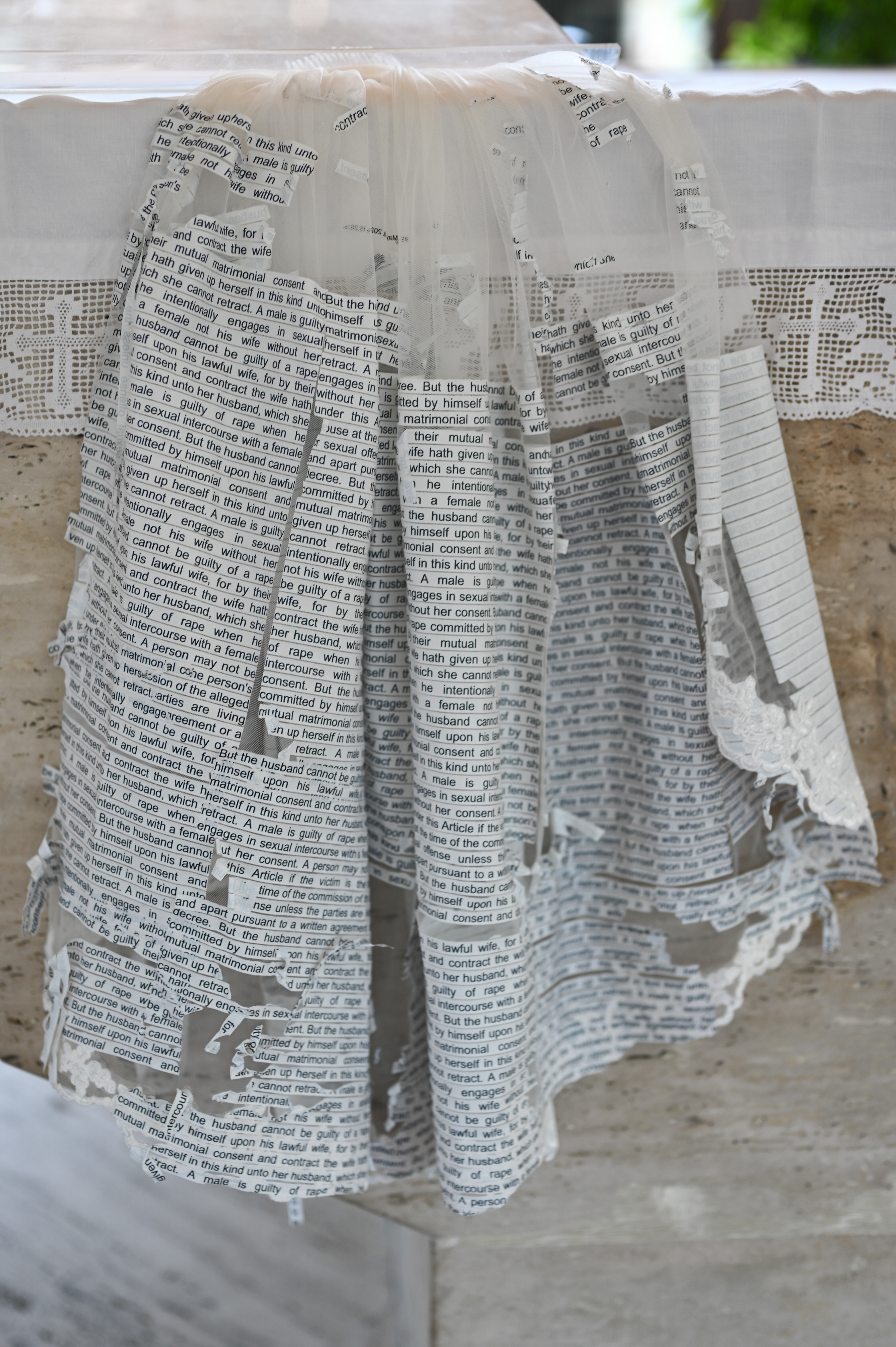
A wedding gown and veil papered entirely in legal text: the marital rape exemption, the doctrine that for most of US history held a husband could not be guilty of raping his lawful wife. Worn as a self-portrait, the bride disappears beneath the very law that once dissolved her consent into the marriage contract. The printed strips fray and lift like the pages of a book, mirroring the slow, piecemeal repeal of these statutes in the late twentieth century.
Ein Brautkleid und Schleier, vollständig mit Gesetzestext beklebt: der Marital Rape Exemption, jener Doktrin, die über weite Teile der US-Geschichte besagte, ein Ehemann könne sich nicht der Vergewaltigung seiner rechtmäßigen Ehefrau schuldig machen. Als Selbstporträt getragen, verschwindet die Braut unter genau jenem Gesetz, das einst ihre Zustimmung im Ehevertrag auflöste. Die bedruckten Streifen fransen aus und lösen sich wie Buchseiten, ein Spiegel der langsamen, stückweisen Abschaffung dieser Gesetze im späten 20. Jahrhundert.
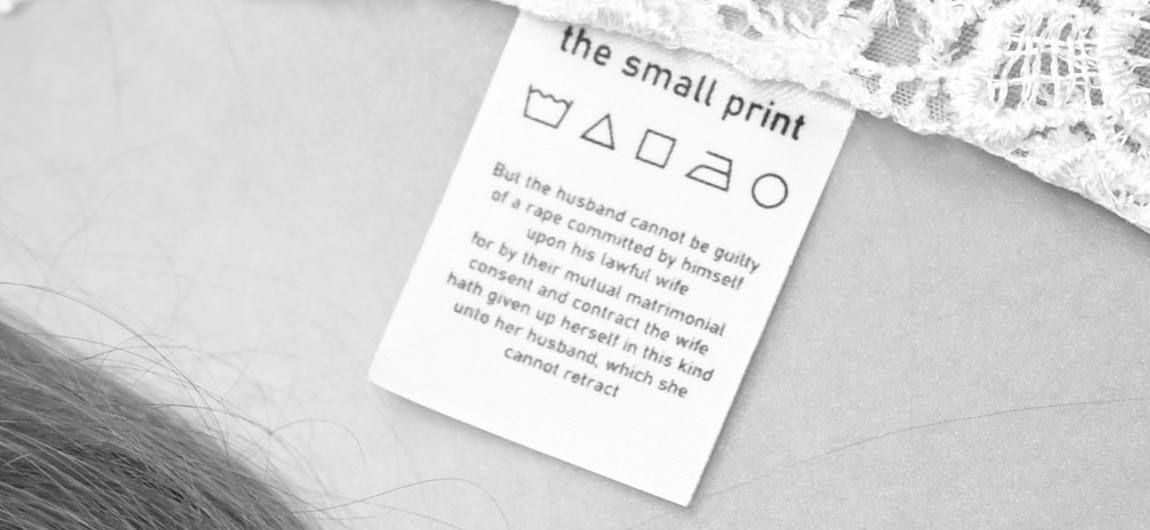
Hidden on the neckline of the dress is a care label. It reads: “the small print: But the husband cannot be guilty of a rape committed by himself upon his lawful wife, for by their mutual matrimonial consent and contract the wife hath given up herself in this kind unto her husband, which she cannot retract.”
This historical eighteenth-century legal doctrine was the law in the USA for a long time, some marital rape exemptions were part of the law until 1993.
Im Ausschnitt des Kleides versteckt sich ein Pflegeetikett. Es liest sich: „the small print: But the husband cannot be guilty of a rape committed by himself upon his lawful wife, for by their mutual matrimonial consent and contract the wife hath given up herself in this kind unto her husband, which she cannot retract.“
Diese historische Rechtsdoktrin aus dem 18. Jahrhundert war in den USA lange Zeit geltendes Recht, manche Marital-Rape-Exemptions blieben bis 1993 Teil der Gesetzgebung.
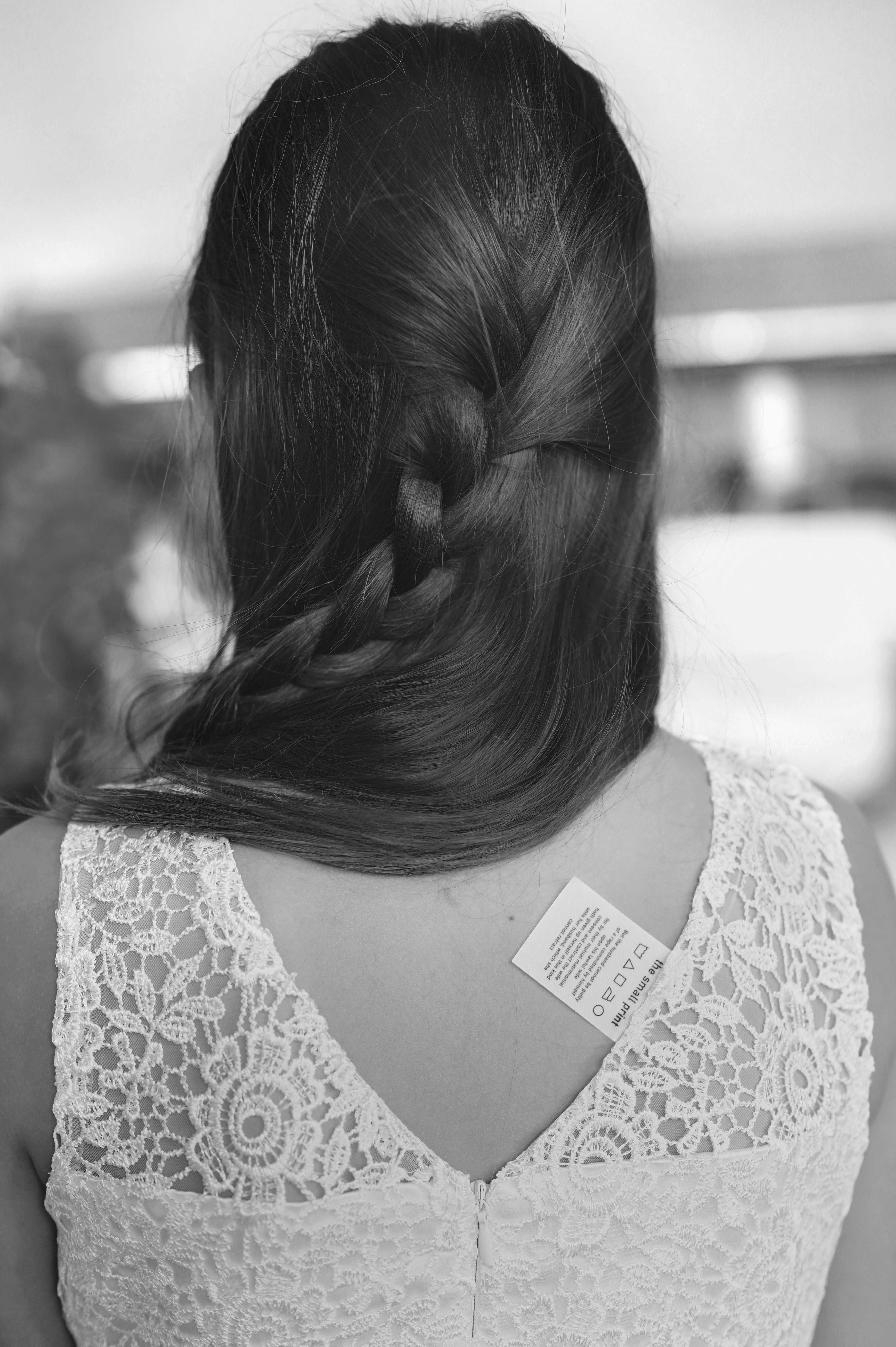
The classic getting-ready shot, with one small detail: hidden on the neckline of the dress, a care label spells out the real conditions of marriage for women for centuries. It reads: “the small print - But the husband cannot be guilty of a rape committed by himself upon his lawful wife, for by their mutual matrimonial consent and contract the wife hath given up herself in this kind unto her husband, which she cannot retract.” This 18th-century legal doctrine remained law in the United States for most of its history.
Das klassische Getting-ready-Foto, mit einem kleinen Detail: Versteckt am Ausschnitt des Kleides benennt ein Pflegeetikett die realen Bedingungen der Ehe für Frauen über Jahrhunderte. Es lautet: „the small print - But the husband cannot be guilty of a rape committed by himself upon his lawful wife, for by their mutual matrimonial consent and contract the wife hath given up herself in this kind unto her husband, which she cannot retract.“ Diese Rechtsdoktrin aus dem 18. Jahrhundert war über weite Teile der US-Geschichte geltendes Recht.
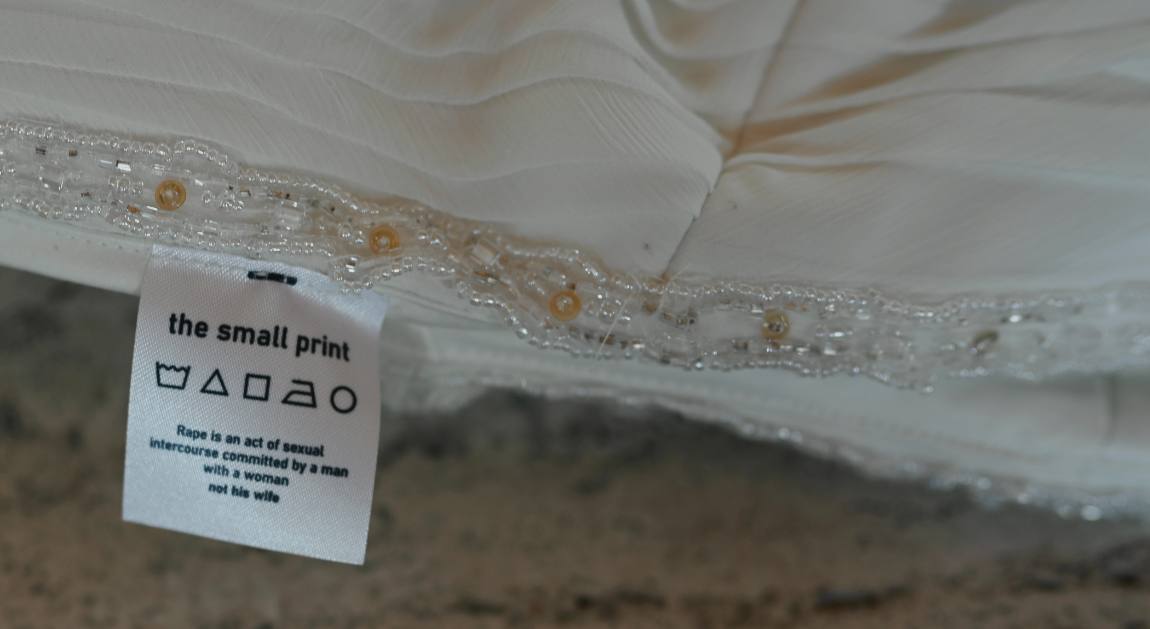
Bound by cable ties, this wedding dress carries the traces of a relationship marked by control. The dress was acquired from a woman in a toxic and abusive marriage. Its care label, added by the artist, contains the small print: “rape is an act of sexual intercourse committed by a man with a woman not his wife.”
Marriage symbolizes mutual commitment and a bond, in reality, many women feel restrained and cannot escape. Although the marital rape exemption has been abolished, it shaped the lives of women for most of American history; remnants of these laws persisted in some jurisdictions until 2019.
Mit Kabelbindern zusammengeschnürt trägt dieses Brautkleid die Spuren einer von Kontrolle geprägten Beziehung. Das Kleid stammt von einer Frau aus einer toxischen, missbräuchlichen Ehe. Sein von der Künstlerin ergänztes Pflegeetikett enthält das Kleingedruckte: „rape is an act of sexual intercourse committed by a man with a woman not his wife.“
Die Ehe steht symbolisch für Verbundenheit, in der Realität fühlen sich viele Frauen gefesselt und finden keinen Ausweg. Obwohl die Marital Rape Exemption abgeschafft wurde, prägte sie das Leben von Frauen über weite Teile der amerikanischen Geschichte; Reste dieser Gesetze bestanden in einzelnen Jurisdiktionen bis 2019.
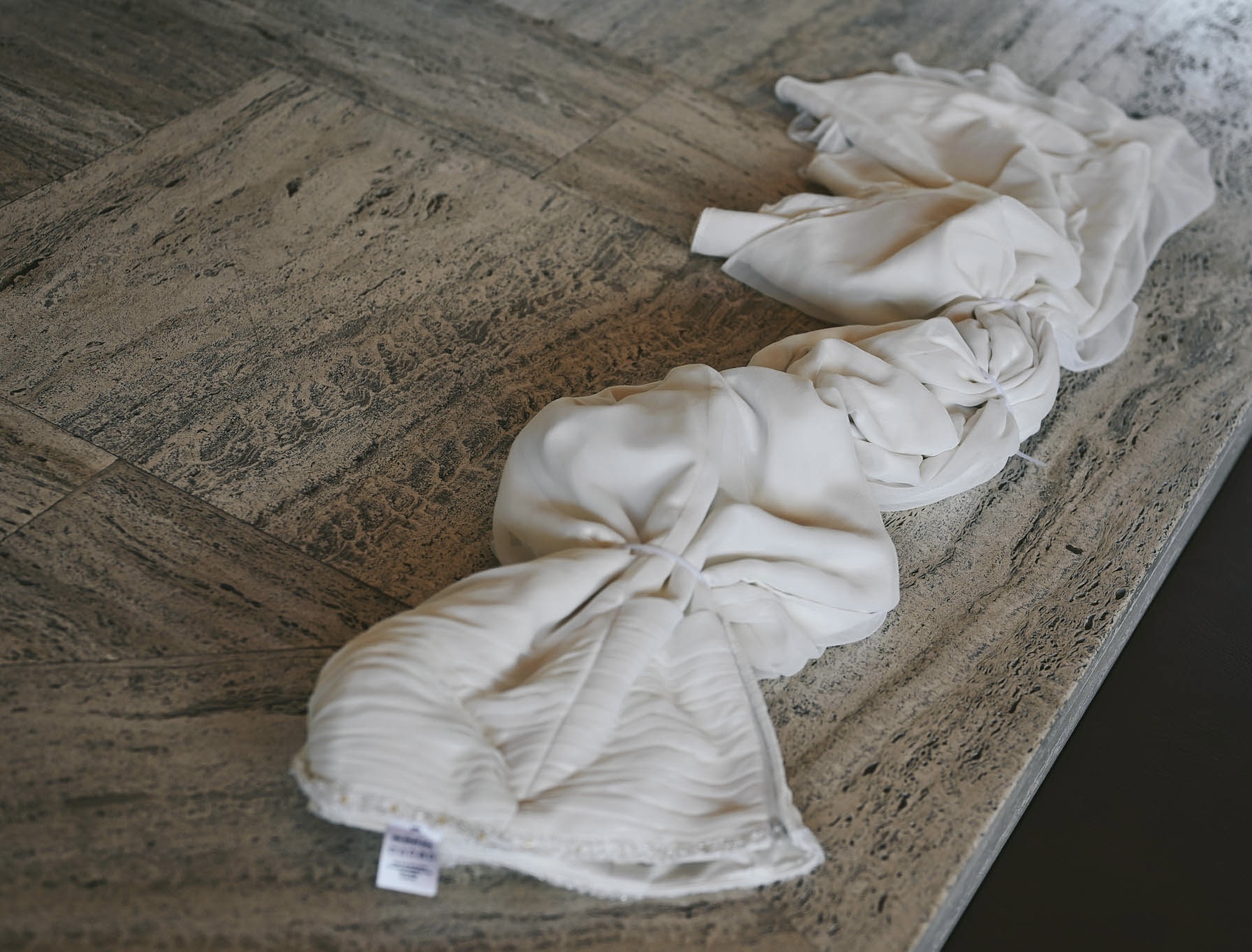
Bound by cable ties, this wedding dress carries the traces of a relationship marked by control. The dress was acquired from a woman in a toxic and abusive marriage. Its care label, added by the artist, contains the small print: a reference to power structures and laws of the past in marriage. It reads: “the small print: rape is an act of sexual intercourse committed by a man with a woman not his wife.”
Marriage symbolizes mutual commitment and a bond; in reality, many women feel restrained and cannot escape. Although the marital rape exemption has been abolished, it shaped the lives of women for most of American history. While all U.S. states formally criminalized marital rape by 1993, remnants of these laws and legal exceptions persisted in some jurisdictions until 2019.
Mit Kabelbindern zusammengeschnürt trägt dieses Brautkleid die Spuren einer von Kontrolle geprägten Beziehung. Das Kleid stammt von einer Frau aus einer toxischen, missbräuchlichen Ehe. Sein von der Künstlerin ergänztes Pflegeetikett enthält das Kleingedruckte: einen Verweis auf vergangene Machtstrukturen und Gesetze in der Ehe. Es lautet: „the small print: rape is an act of sexual intercourse committed by a man with a woman not his wife.“
Die Ehe steht symbolisch für Verbundenheit, in der Realität fühlen sich viele Frauen gefesselt und finden keinen Ausweg. Obwohl die Marital Rape Exemption abgeschafft wurde, prägte sie das Leben von Frauen über weite Teile der amerikanischen Geschichte. Während alle US-Bundesstaaten Vergewaltigung in der Ehe bis 1993 formal unter Strafe stellten, bestanden Reste dieser Gesetze und rechtlichen Ausnahmen in einzelnen Jurisdiktionen bis 2019.
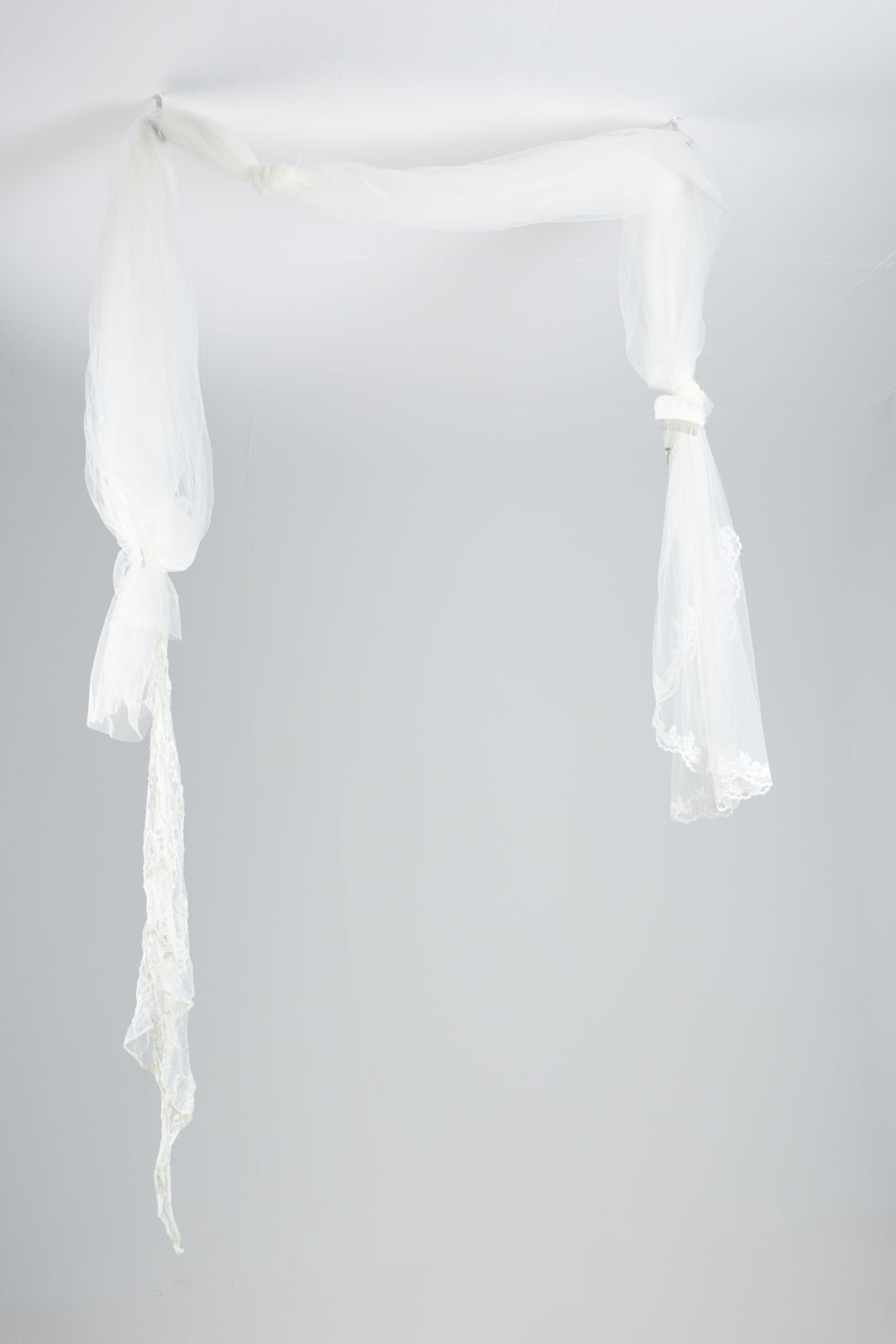
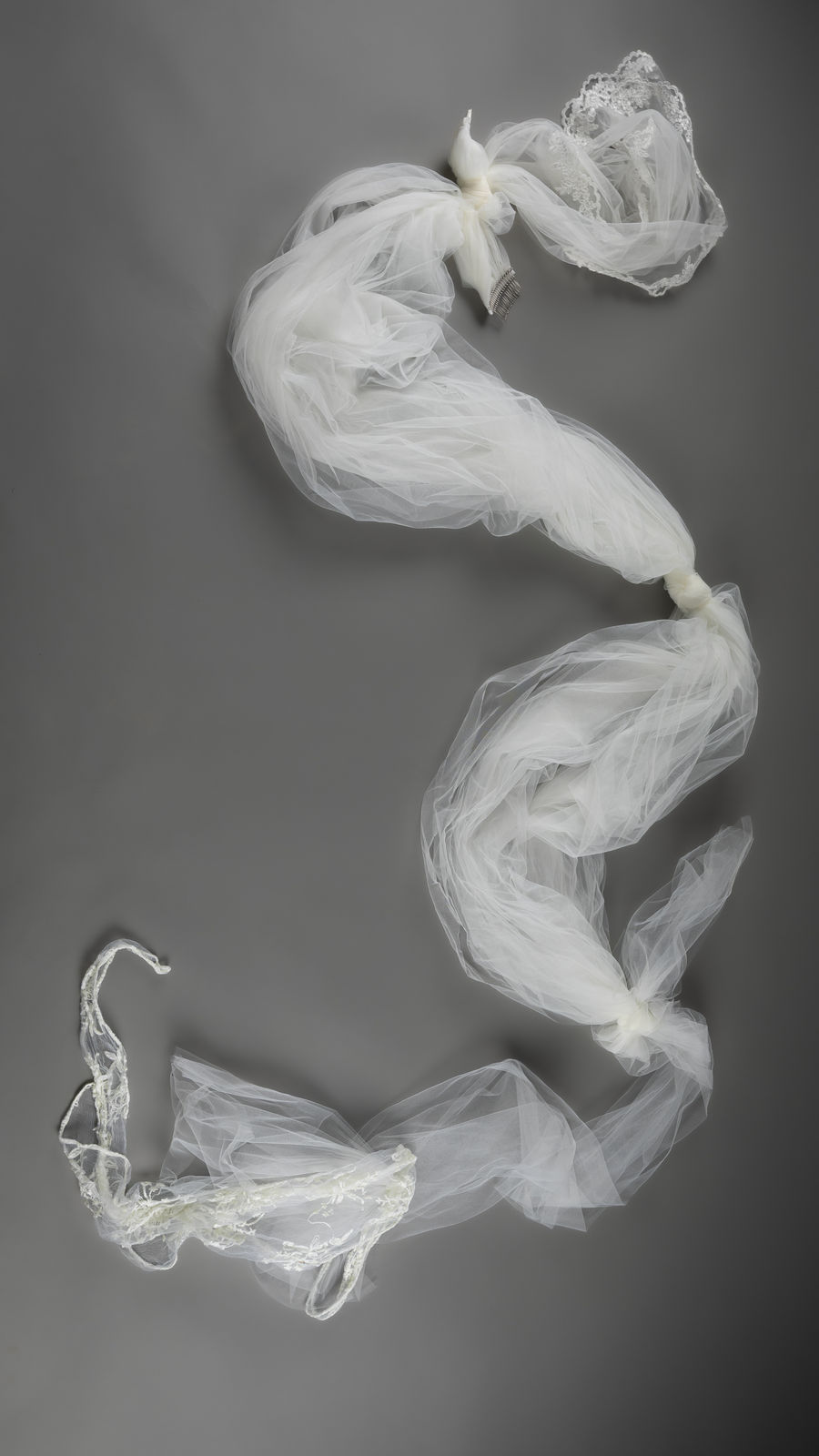
Bridal veils and veil fabric are knotted together to form an improvised escape rope, referring to bedsheets tied together to escape through a window. The bridal veil, usually a symbol of marriage, is transformed into an object for escape.
The work reflects on the generations of women who fought for the right to leave a marriage and for fair divorce laws.
The veils tied to one another also visualize this historical process, each one dependent on the one before it: the freedom of one generation grows from the struggles and fights of those who came before.
Brautschleier und Schleierstoff werden miteinander verknotet und bilden ein improvisiertes Fluchtseil – in Anlehnung an Bettlaken, die zusammengebunden werden, um durch ein Fenster zu entkommen. Der Brautschleier, gewöhnlich ein Symbol der Ehe, wird zu einem Gegenstand der Flucht.
Die Arbeit reflektiert die Generationen von Frauen, die für das Recht kämpften, eine Ehe verlassen zu können, und für gerechte Scheidungsgesetze eintraten.
Die miteinander verbundenen Schleier veranschaulichen zugleich diesen historischen Prozess, jeder ist vom vorhergehenden abhängig: Die Freiheit einer Generation erwächst aus den Kämpfen derjenigen, die vor ihr kamen.
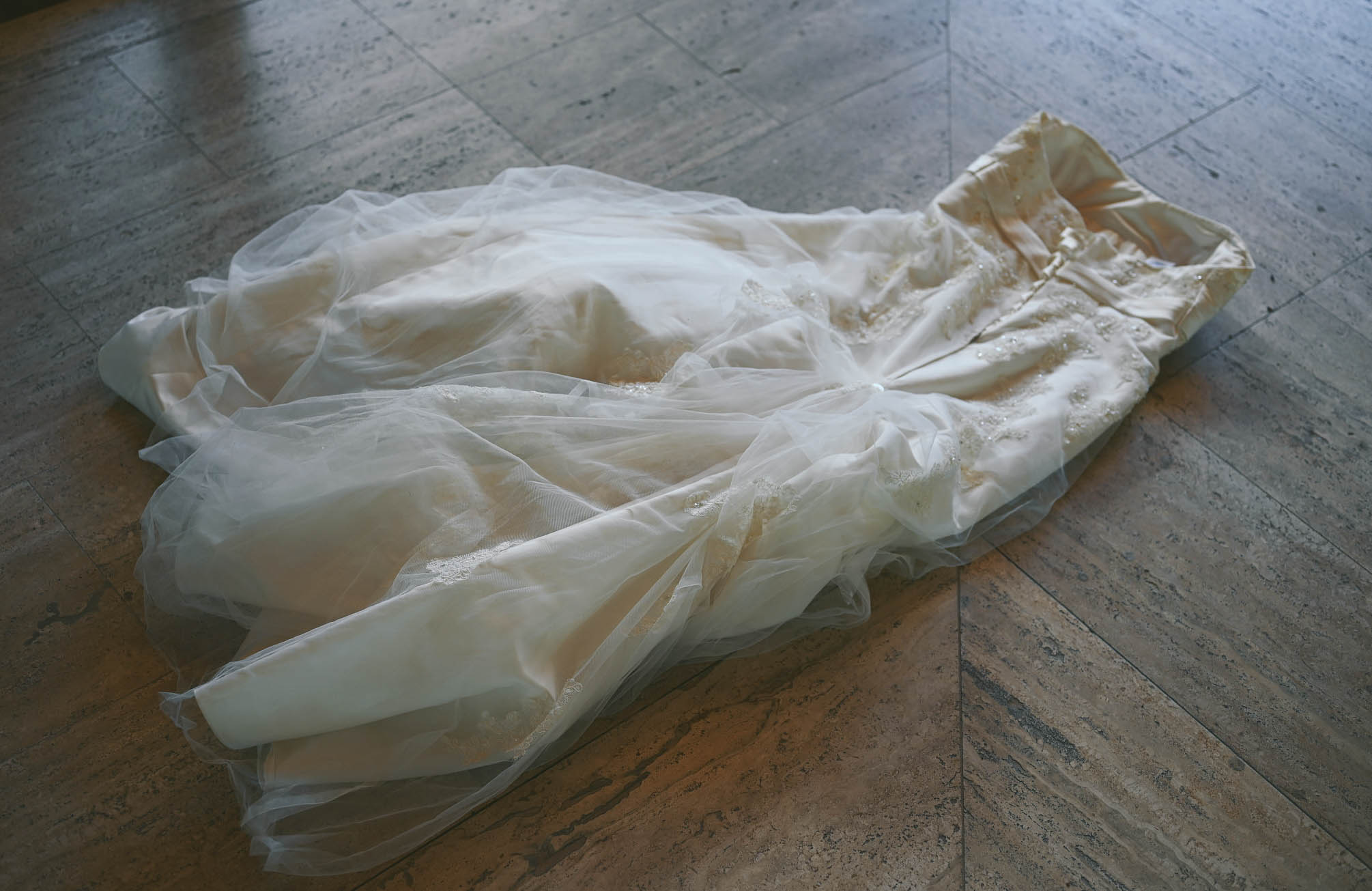
The bridal dress belonged to a woman trapped in a toxic marriage. The idea was to place a historical marital rape exemption clause as the garment's care label. It reads: “the small print: Delaware Code Tit. 11 §763: A male is guilty of rape when he intentionally engages in sexual intercourse with a female not his wife without her consent.” Amended only in 1974, this means most of our grandmothers still lived under this law, it remained the law for almost 200 of the USA's 250 years.
The artwork subtly exposes the conditions embedded within the institution of marriage throughout history. Weddings are celebrated as a symbol of commitment and choosing each other, but historically marriage was often a contract of ownership: its clauses written by men. For centuries under Western common law, the doctrine of coverture dictated that a woman's legal identity was absorbed by her husband upon marriage, making her body his legal property.
While all U.S. states formally criminalized marital rape by 1993, the laws persisted through exemptions and loopholes in some jurisdictions until as late as 2019.
Das Brautkleid gehörte einer Frau, die in einer toxischen Ehe gefangen war. Die Idee war, eine historische Marital-Rape-Exemption-Klausel als Pflegeetikett in das Kleid einzunähen. Es lautet: „the small print: Delaware Code Tit. 11 §763: A male is guilty of rape when he intentionally engages in sexual intercourse with a female not his wife without her consent.“ Erst 1974 geändert, bedeutet das: Die meisten unserer Großmütter erlebten dieses Gesetz noch, es galt fast 200 der 250 Jahre US-Geschichte.
Die Arbeit legt auf subtile Weise die Bedingungen offen, die historisch in der Institution der Ehe eingeschrieben waren. Hochzeiten werden als Symbol der gegenseitigen Wahl gefeiert, historisch war die Ehe jedoch oft ein Besitzvertrag, dessen Klauseln von Männern geschrieben wurden. Nach westlichem Common Law bestimmte über Jahrhunderte die Doktrin der Coverture, dass die rechtliche Identität einer Frau mit der Eheschließung im Ehemann aufging: ihr Körper wurde sein rechtliches Eigentum.
Während alle US-Bundesstaaten Vergewaltigung in der Ehe bis 1993 formal unter Strafe stellten, bestanden die Gesetze durch Ausnahmen und Gesetzeslücken in einzelnen Jurisdiktionen bis ins Jahr 2019 fort.
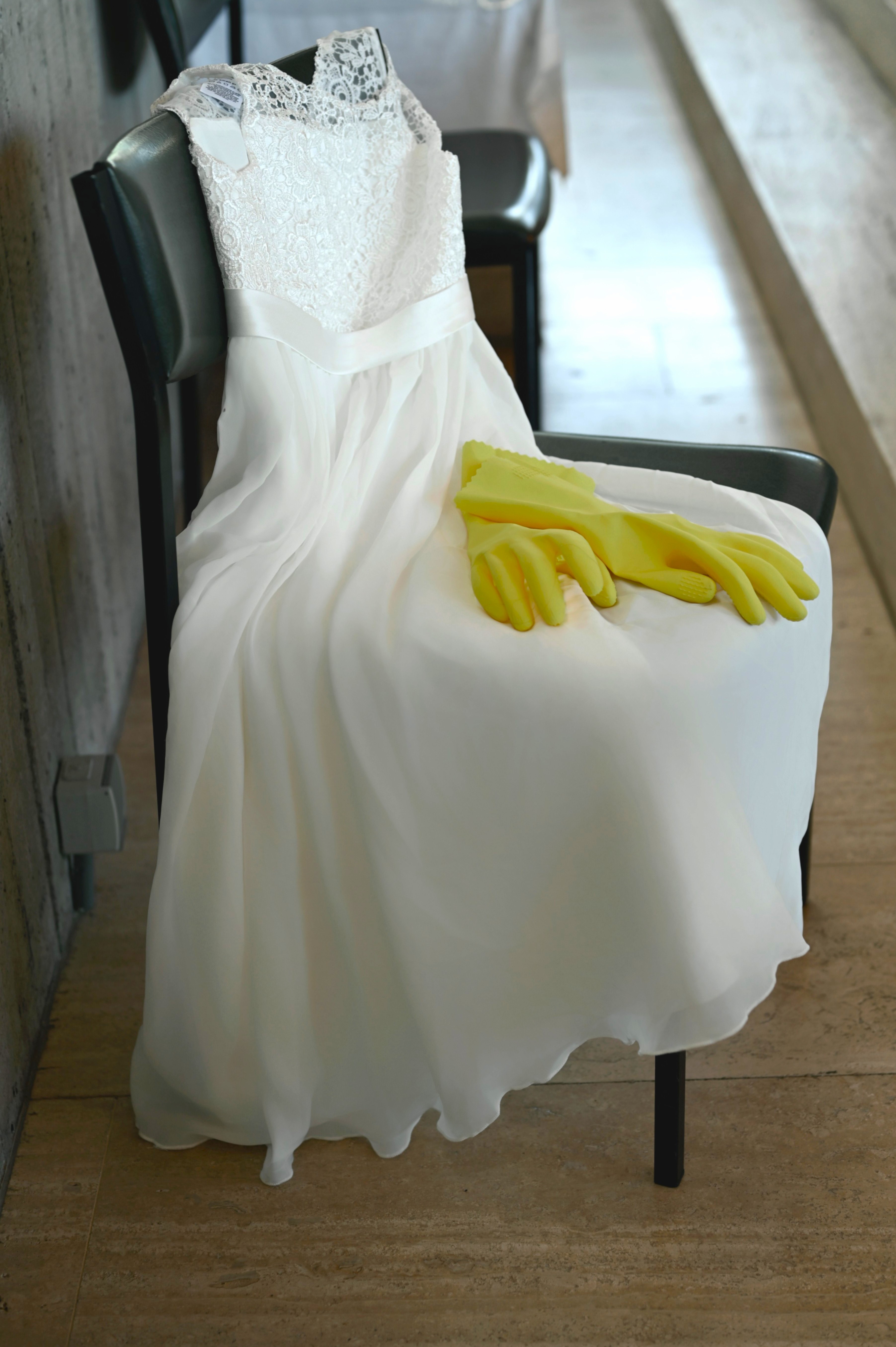
The domestic gloves, stripped of the hands that animate them, become a symbol of care work that is often taken for granted, undervalued, and rendered invisible. By juxtaposing the romantic symbolism of the wedding dress with the mundane tools of domestic labour, the work questions the unequal expectations embedded within the institution of marriage.
Die Haushaltshandschuhe, entkleidet der Hände, die sie beleben, werden zum Symbol für Care-Arbeit, die oft als selbstverständlich hingenommen, unterbewertet und unsichtbar gemacht wird. Indem die romantische Symbolik des Brautkleides den banalen Werkzeugen häuslicher Arbeit gegenübergestellt wird, hinterfragt die Arbeit die ungleichen Erwartungen, die der Institution der Ehe eingeschrieben sind.
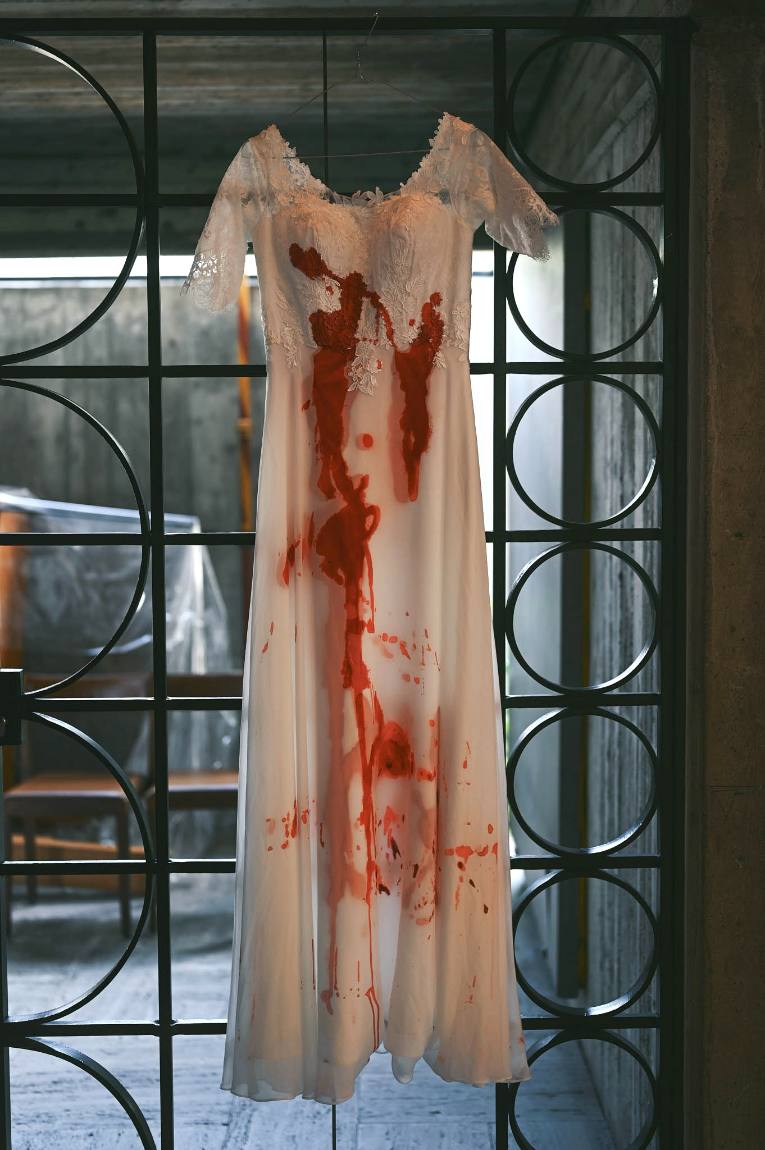
For women, marriage or a relationship with a man can have a fatal end. A blood-stained, empty wedding dress serves as a memorial to the irreversible. While the dress stands for the societal idealization of marriage, the stains represent violence: the visualization of a statistic.
The dress is empty; the woman who should be wearing it is gone. The work explores the void left behind by femicide.
Für Frauen kann die Ehe oder eine Beziehung mit einem Mann tödlich enden. Ein blutbeflecktes, leeres Brautkleid fungiert als Denkmal für das Unwiderrufliche. Während das Kleid für die gesellschaftliche Idealisierung der Ehe steht, repräsentieren die Spuren die Gewalt: die Visualisierung einer Statistik.
Das Kleid ist leer; die Frau, die es tragen sollte, ist fort. Die Arbeit erkundet die Leerstelle, die der Femizid hinterlässt.
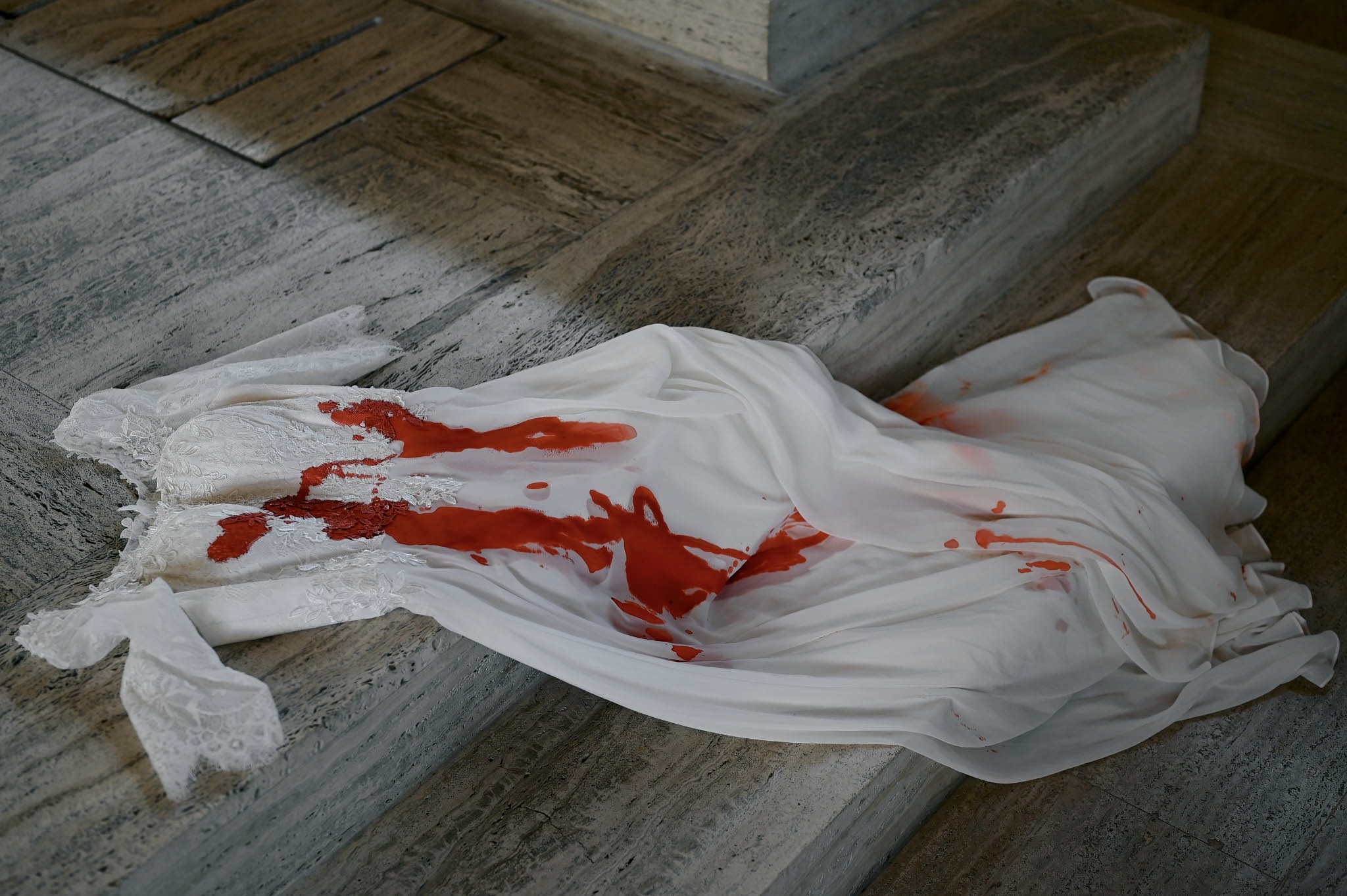
For women, marriage or a relationship with a man can have a fatal end.
A wedding dress may appear very direct, but it is a potent visual symbol. It is linked to societal expectations of love and a happy future, as well as the personal hopes of the bride. The stains on the fabric serve as a memorial to the irreversible. While the dress stands for the societal idealization of marriage, the blood represents violence. It is the visualization of a statistic. The goal is to make it visible that violence against women often occurs in relationships which should mean love and trust.
The dress is empty. The woman who should be wearing it is gone. The artwork explores the void left behind by femicide.
Für Frauen kann die Ehe oder eine Beziehung mit einem Mann tödlich enden.
Ein Brautkleid mag sehr direkt wirken, ist aber ein kraftvolles visuelles Symbol. Es ist verknüpft mit gesellschaftlichen Erwartungen an Liebe und eine glückliche Zukunft sowie den persönlichen Hoffnungen der Braut. Die Flecken auf dem Stoff dienen als Denkmal für das Unwiderrufliche. Während das Kleid für die gesellschaftliche Idealisierung der Ehe steht, steht das Blut für Gewalt. Es ist die Visualisierung einer Statistik. Ziel ist es, sichtbar zu machen, dass Gewalt gegen Frauen oft in Beziehungen geschieht, die eigentlich Liebe und Vertrauen bedeuten sollten.
Das Kleid ist leer. Die Frau, die es tragen sollte, ist fort. Die Arbeit erkundet die Leerstelle, die der Femizid hinterlässt.
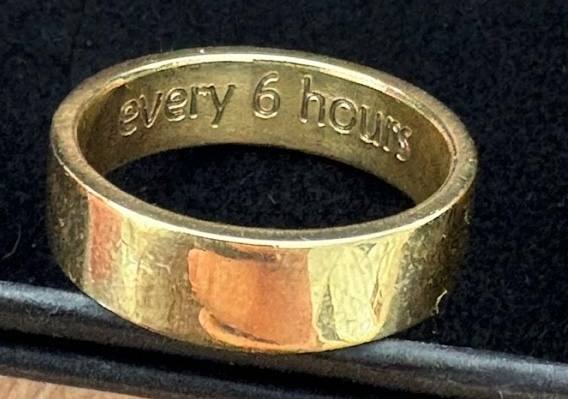
A golden brass wedding ring. Instead of a romantic engraving, it carries a statistic: in the United States, a woman is killed about every six hours; by a current or former partner every 8 hours. The ring, a symbol of love, commitment and protection, becomes a symbol of ownership, control and the potential fatality embedded within patriarchal structures. The work reflects on gender-based violence, the normalization of misogyny, and the disturbing reality that intimacy can become fatal for women simply because they are women.
Ein goldener Ehering aus Messing. Statt einer romantischen Gravur trägt er eine Statistik: In den USA wird etwa alle sechs Stunden eine Frau getötet; von einem aktuellen oder ehemaligen Partner etwa alle 8 Stunden. Der Ring, Symbol für Liebe, Verbindlichkeit und Schutz, wird zum Symbol für Besitz, Kontrolle und die potenzielle Tödlichkeit patriarchaler Strukturen. Die Arbeit reflektiert geschlechtsspezifische Gewalt, die Normalisierung von Frauenfeindlichkeit und die verstörende Realität, dass Nähe für Frauen allein deshalb tödlich enden kann, weil sie Frauen sind.
Raphaela Stella Leys is the sole artistic author of this work. She developed the artistic concept, creative direction, staging, costume design, props, and overall visual composition. The photographs were executed with the technical assistance of a photographer acting under her direction, without creative input into the work.Raphaela Stella Leys ist die alleinige künstlerische Urheberin dieser Arbeit. Sie entwickelte das künstlerische Konzept, die künstlerische Leitung, Inszenierung, Kostümgestaltung, Requisiten sowie die gesamte visuelle Komposition. Die Fotografien wurden mit technischer Unterstützung eines unter ihrer Anleitung tätigen Fotografen umgesetzt, ohne kreativen Beitrag zur Arbeit.
← ALL SERIESALLE SERIEN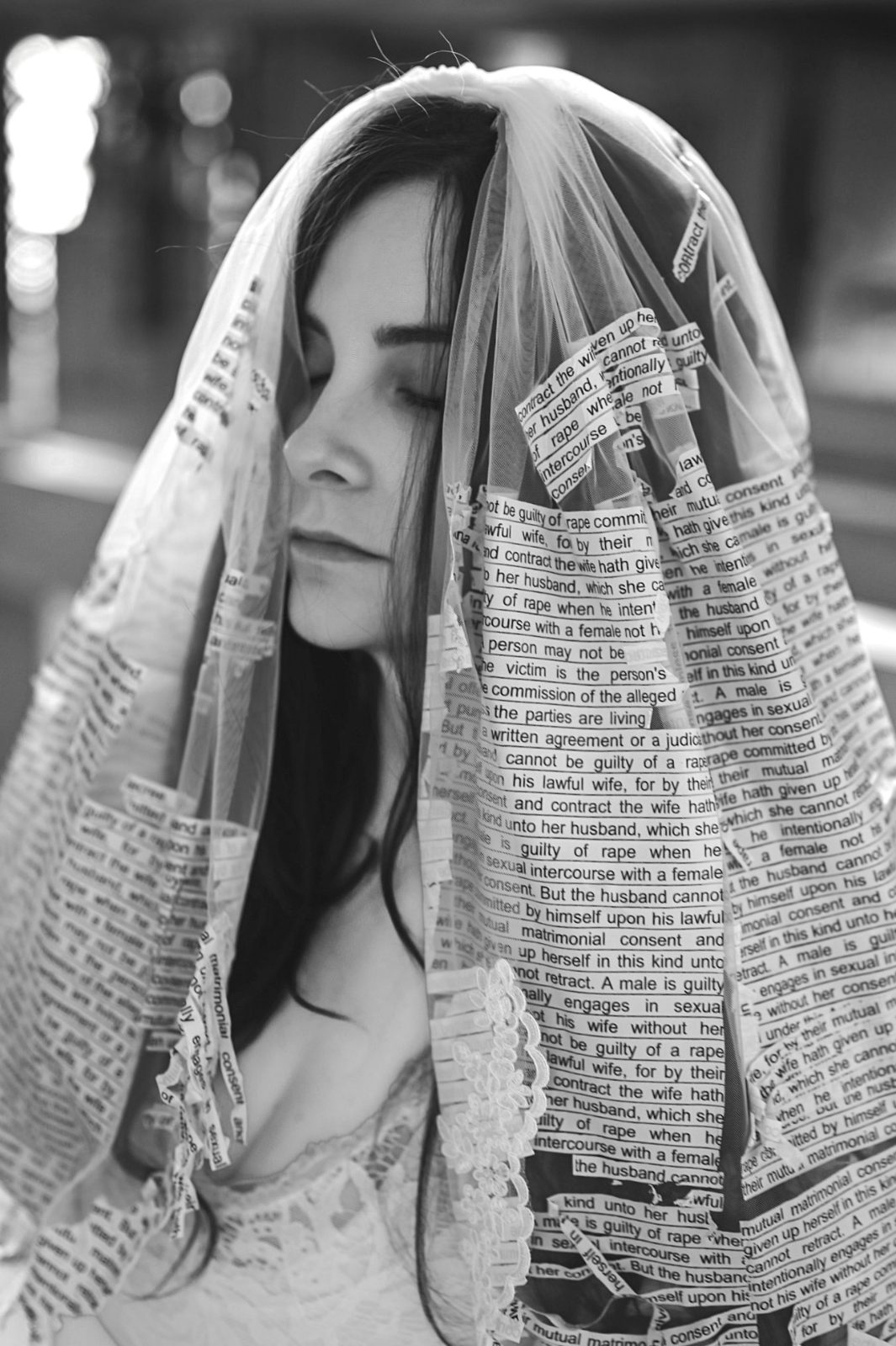
EXHIBITIONSAUSSTELLUNGEN
2026 — SAVE / DIE / RETRY
Group Exhibition — A Space Gallery, Brooklyn, New York, USAGruppenausstellung — A Space Gallery, Brooklyn, New York, USA
Oct 28 – Nov 6, 202628. Okt. – 6. Nov. 2026
2026 — Feminism 250: Woman Made America
Group Exhibition — Woman Made Gallery, Chicago, Illinois, USAGruppenausstellung — Woman Made Gallery, Chicago, Illinois, USA
Aug 29 – Sept 26, 202629. Aug. – 26. Sept. 2026
2026 — this is a show about grief
Group Exhibition — Ghost Gallery, Seattle, Washington, USAGruppenausstellung — Ghost Gallery, Seattle, Washington, USA
Sept 11 – Oct 04, 202611. Sept. – 04. Okt. 2026
2026 — Her Canvas Art Exhibition
Online Group Exhibition — Blue Koi GalleryOnline-Gruppenausstellung — Blue Koi Gallery
2026 — ANIMA MUNDI 2026
Group Exhibition — Palazzo Albrizzi-Capello, Venice, ItalyGruppenausstellung — Palazzo Albrizzi-Capello, Venedig, Italien
Sept 18 – Oct 02, 202618. Sept. – 02. Okt. 2026
2026 — Politics and Art
Online Group Exhibition — Las Laguna Art Gallery, Laguna Beach, California, USAOnline-Gruppenausstellung — Las Laguna Art Gallery, Laguna Beach, Kalifornien, USA
Dec 30, 2025 – Jul 01, 202630. Dez. 2025 – 01. Juli 2026

ARTIST STATEMENTKÜNSTLERISCHES STATEMENT
My artistic practice takes a critical approach to contemporary society, exploring themes such as feminism, violence, care, digital culture, militarization, consumerism, and the medicalization of everyday life. Through conceptual visual narratives, I investigate how social norms and institutional structures shape individual experience and collective behavior.
Meine künstlerische Praxis nimmt eine kritische Haltung gegenüber der zeitgenössischen Gesellschaft ein und erkundet Themen wie Feminismus, Gewalt, Fürsorge, digitale Kultur, Militarisierung, Konsum und die Medikalisierung des Alltags. Durch konzeptuelle visuelle Narrative untersuche ich, wie gesellschaftliche Normen und institutionelle Strukturen individuelles Erleben und kollektives Verhalten prägen.
Working with symbolism, contemporary visual language, historical references, and object-based interventions, I examine the relationship between the individual and society.
Mit Symbolik, zeitgenössischer Bildsprache, historischen Referenzen und objektbasierten Interventionen untersuche ich das Verhältnis zwischen Individuum und Gesellschaft.
My projects address subjects including femicide, digital childhood, coercive social norms, pharmaceutical culture, and the commercialization of well-being.
Meine Projekte behandeln Themen wie Femizid, digitale Kindheit, zwanghafte gesellschaftliche Normen, pharmazeutische Kultur und die Kommerzialisierung des Wohlbefindens.
Rather than offering definitive answers, I seek to create moments of reflection that reveal the invisible mechanisms through which violence, inequality, and social expectations become normalized. My background in history, philosophy, psychology, and ethics strongly informs both the conceptual development of my work and my research-based artistic practice.
Statt endgültige Antworten zu geben, möchte ich Momente der Reflexion schaffen, die die unsichtbaren Mechanismen offenlegen, durch die Gewalt, Ungleichheit und gesellschaftliche Erwartungen normalisiert werden. Mein Hintergrund in Geschichte, Philosophie, Psychologie und Ethik prägt sowohl die konzeptuelle Entwicklung meiner Arbeit als auch meine forschungsbasierte künstlerische Praxis.
BIOGRAPHYBIOGRAFIE
Mag. Raphaela Stella Leys MA works with conceptual visual narratives exploring feminism, violence, care, digital culture, militarization, consumerism, and the medicalization of everyday life. Drawing from art history, symbolism, contemporary media imagery, and personal observation, her work examines the construction of femininity, vulnerability, and power within modern society.
Her ongoing bodies of work include The Bridal Series, which dismantles the institution of marriage through minimal interventions in the wedding gown, veil, and ring; Human Maintenance, on the medicalization of grief and the pressure to remain functional; Back to School, on the commercialization of school safety and the militarization of the classroom; and Don't Forget to Smile, on the everyday reality of being a woman in public space.
From 2011 to 2013, she worked as a personal care assistant for a man who used a wheelchair, and from 2017 to 2023 she cared for her grandmother. She is also a mother of three children. This experience of care work informs her recurring engagement with vulnerability, dependency, and the often invisible labour of looking after others.
Mag. Raphaela Stella Leys MA arbeitet mit konzeptuellen visuellen Narrativen zu Feminismus, Gewalt, Fürsorge, digitaler Kultur, Militarisierung, Konsum und der Medikalisierung des Alltags. Ausgehend von Kunstgeschichte, Symbolik, zeitgenössischer Medienbildsprache und persönlicher Beobachtung untersucht ihre Arbeit die Konstruktion von Weiblichkeit, Verletzlichkeit und Macht in der modernen Gesellschaft.
Zu ihren fortlaufenden Werkgruppen zählen The Bridal Series, die die Institution der Ehe durch minimale Eingriffe in Brautkleid, Schleier und Ehering dekonstruiert; Human Maintenance, über die Medikalisierung von Trauer und den Druck, funktionsfähig zu bleiben; Back to School, über die Kommerzialisierung von Schulsicherheit und die Militarisierung des Klassenzimmers; sowie Don't Forget to Smile, über die alltägliche Realität, als Frau im öffentlichen Raum unterwegs zu sein.
Von 2011 bis 2013 arbeitete sie als persönliche Betreuerin für einen Mann, der auf einen Rollstuhl angewiesen war, von 2017 bis 2023 pflegte sie ihre Großmutter. Zudem ist sie Mutter von drei Kindern. Diese Erfahrung in der Care-Arbeit prägt ihre wiederkehrende Auseinandersetzung mit Verletzlichkeit, Abhängigkeit und der oft unsichtbaren Arbeit der Fürsorge für andere.
EXHIBITIONSAUSSTELLUNGEN
2026 — Feminism 250: Woman Made America
Group Exhibition — Woman Made Gallery, Aug 29 - Sept 02, Chicago, Illinois, USAGruppenausstellung — Woman Made Gallery, 29. Aug. - 02. Sept., Chicago, Illinois, USA
2026 — ANIMA MUNDI 2026
Group Exhibition — Palazzo Albrizzi-Capello, Sept 18 – Oct 02, Venice, ItalyGruppenausstellung — Palazzo Albrizzi-Capello, 18. Sept – 02. Okt., Venedig, Italien
2026 — this is a show about grief
Group Exhibition — Ghost Gallery, Sept 11 – Oct 4, Seattle, Washington, USAGruppenausstellung — Ghost Gallery, 11. Sept – 4. Okt., Seattle, Washington, USA
2026 — Politics and Art
Online Group Exhibition — Las Laguna Art Gallery, Dec 30, 2025 – Jul 01, 2026, Laguna Beach, California, USAOnline-Gruppenausstellung — Las Laguna Art Gallery, 30. Dez. 2025 – 01. Juli 2026, Laguna Beach, Kalifornien, USA
2026 — Her Canvas Art Exhibition
Juried Online Group Exhibition — Blue Koi Gallery, OnlineJurierte Online-Gruppenausstellung — Blue Koi Gallery, Online
EDUCATIONAUSBILDUNG
Master's Degree in Ethics, University of ViennaMasterstudium Ethik, Universität Wien
Completed 2024 with distinctionAbschluss 2024 mit Auszeichnung
Her master's thesis examined questions of guilt, responsibility, and historical accountability in postwar Austria within the context of the Austrian “victim theory” surrounding National Socialism. Drawing on thinkers such as Karl Jaspers, Hannah Arendt, and Aleida Assmann, the thesis explored collective guilt, the banality of evil, and intergenerational responsibility, while also developing educational approaches for ethics teaching.
Ihre Masterarbeit untersuchte Fragen von Schuld, Verantwortung und historischer Verantwortlichkeit im Nachkriegsösterreich im Kontext der österreichischen „Opferthese“ rund um den Nationalsozialismus. Ausgehend von Denker:innen wie Karl Jaspers, Hannah Arendt und Aleida Assmann erkundete die Arbeit kollektive Schuld, die Banalität des Bösen und intergenerationelle Verantwortung und entwickelte zugleich didaktische Ansätze für den Ethikunterricht.
Teacher Training Studies (Diploma/Magister — equivalent to a Master's degree), University of ViennaLehramtsstudium (Diplom/Magister — äquivalent zu einem Master), Universität Wien
History, Social Studies and Political Education, Psychology and Philosophy — completed 2020 with distinctionGeschichte, Sozialkunde und Politische Bildung, Psychologie und Philosophie — Abschluss 2020 mit Auszeichnung
Her diploma thesis explored feminist perspectives on peace activism in Austria, examining continuities and ruptures between pacifist movements before World War I and those of the 1980s.
Ihre Diplomarbeit untersuchte feministische Perspektiven auf den Friedensaktivismus in Österreich und beleuchtete Kontinuitäten und Brüche zwischen den pazifistischen Bewegungen vor dem Ersten Weltkrieg und jenen der 1980er-Jahre.
Studies in History, University of InnsbruckStudium der Geschichte, Universität Innsbruck
With accompanying studies in Philosophy and Educational Sciences, 2010–2013Mit Begleitstudien in Philosophie und Bildungswissenschaften, 2010–2013
CONTACTKONTAKT
LEGAL NOTICEIMPRESSUM
Information pursuant to § 5 of the Austrian E-Commerce Act (ECG).
Angaben gemäß § 5 ECG.
NameName
Raphaela Leys
Field of activityTätigkeitsbereich
Fine Art / Contemporary ArtBildende Kunst / Zeitgenössische Kunst
Responsible for content pursuant to § 25 Austrian Media ActVerantwortlich für den Inhalt gemäß § 25 Mediengesetz
Raphaela Leys
COPYRIGHTURHEBERRECHT
All content published on this website, in particular artworks, photographs, texts and designs, is protected by copyright. Any use, reproduction, distribution or other exploitation beyond the limits set by law requires the prior written consent of Raphaela Leys.
Sämtliche auf dieser Website veröffentlichten Inhalte, insbesondere Kunstwerke, Fotografien, Texte und Gestaltungen, sind urheberrechtlich geschützt. Jede Nutzung, Vervielfältigung, Verbreitung oder sonstige Verwertung außerhalb der gesetzlichen Grenzen bedarf der vorherigen schriftlichen Zustimmung von Raphaela Leys.
LIABILITY FOR CONTENTHAFTUNG FÜR INHALTE
The content of this website has been created with the greatest possible care. However, no guarantee is given for the accuracy, completeness or timeliness of the information provided.
Die Inhalte dieser Website wurden mit größtmöglicher Sorgfalt erstellt. Dennoch wird keine Gewähr für die Richtigkeit, Vollständigkeit oder Aktualität der bereitgestellten Informationen übernommen.
LIABILITY FOR EXTERNAL LINKSHAFTUNG FÜR EXTERNE LINKS
This website may contain links to external third-party websites. No liability is assumed for their content. Sole responsibility for the content of linked pages lies with their respective operators.
Diese Website kann Links zu externen Websites Dritter enthalten. Für deren Inhalte wird keine Haftung übernommen. Für den Inhalt der verlinkten Seiten sind ausschließlich deren jeweilige Betreiber verantwortlich.
PRIVACY POLICYDATENSCHUTZERKLÄRUNG
Responsible partyVerantwortliche
Raphaela Stella Leys
Hosting / server log filesHosting / Server-Logfiles
When you visit this website, the hosting provider automatically processes technical data (IP address, date and time, browser type) in server log files. This is required for the secure operation of the site (Art. 6 (1) f GDPR) and is not merged with other data.Beim Besuch dieser Website verarbeitet der Hosting-Anbieter automatisch technische Daten (IP-Adresse, Datum und Uhrzeit, Browsertyp) in Server-Logfiles. Dies ist für den sicheren Betrieb der Seite erforderlich (Art. 6 Abs. 1 lit. f DSGVO) und wird nicht mit anderen Daten zusammengeführt.
Cookies & local storageCookies & Local Storage
This website does not use tracking cookies or analytics. Your language preference is stored locally in your browser (localStorage) and is never transmitted.Diese Website verwendet keine Tracking-Cookies und keine Analyse-Tools. Ihre Spracheinstellung wird lokal in Ihrem Browser gespeichert (localStorage) und nicht übertragen.
FontsSchriften
All fonts are hosted on this website's own server. No connection to third-party font services is established.Alle Schriften werden auf dem eigenen Server dieser Website gehostet. Es wird keine Verbindung zu Schriftdiensten Dritter aufgebaut.
Contact form and e-mailKontaktformular und E-Mail
If you contact the studio using the contact form or by e-mail, your message and contact details are processed solely to handle your enquiry (Art. 6 (1) b GDPR). Form submissions are processed by the hosting provider Netlify.Bei Kontaktaufnahme über das Kontaktformular oder per E-Mail werden Ihre Nachricht und Kontaktdaten ausschließlich zur Bearbeitung Ihrer Anfrage verarbeitet (Art. 6 Abs. 1 lit. b DSGVO). Formulareinsendungen werden durch den Hosting-Anbieter Netlify verarbeitet.
Your rightsIhre Rechte
You have the right to information, rectification, erasure and restriction of the processing of your personal data, as well as the right to lodge a complaint with a supervisory authority.Sie haben das Recht auf Auskunft, Berichtigung, Löschung und Einschränkung der Verarbeitung Ihrer personenbezogenen Daten sowie ein Beschwerderecht bei einer Aufsichtsbehörde.